

I remember the first time I walked through Iford Playing Fields on a cold morning, the grass still damp, the river quietly sliding past like it had all the time in the world. Nothing looked dangerous there. Kids kicked footballs around, dog walkers waved as they passed, and the whole place felt like one of those rare corners where life slows down.
So when I first heard people talking about the riverbank collapse Iford Playing Fields, I honestly thought they were exaggerating. Riverbanks don’t just suddenly give up—right?
Turns out, they can, and they did.
When the Ground Starts Cracking Under Your Feet
One of the oddest things about erosion is that it gives little hints before it makes a big move. Someone mentioned seeing small cracks appear by the water’s edge weeks before the main slip. Another said they’d noticed the footpath getting narrower, the way cliffs do in those coastal documentaries.
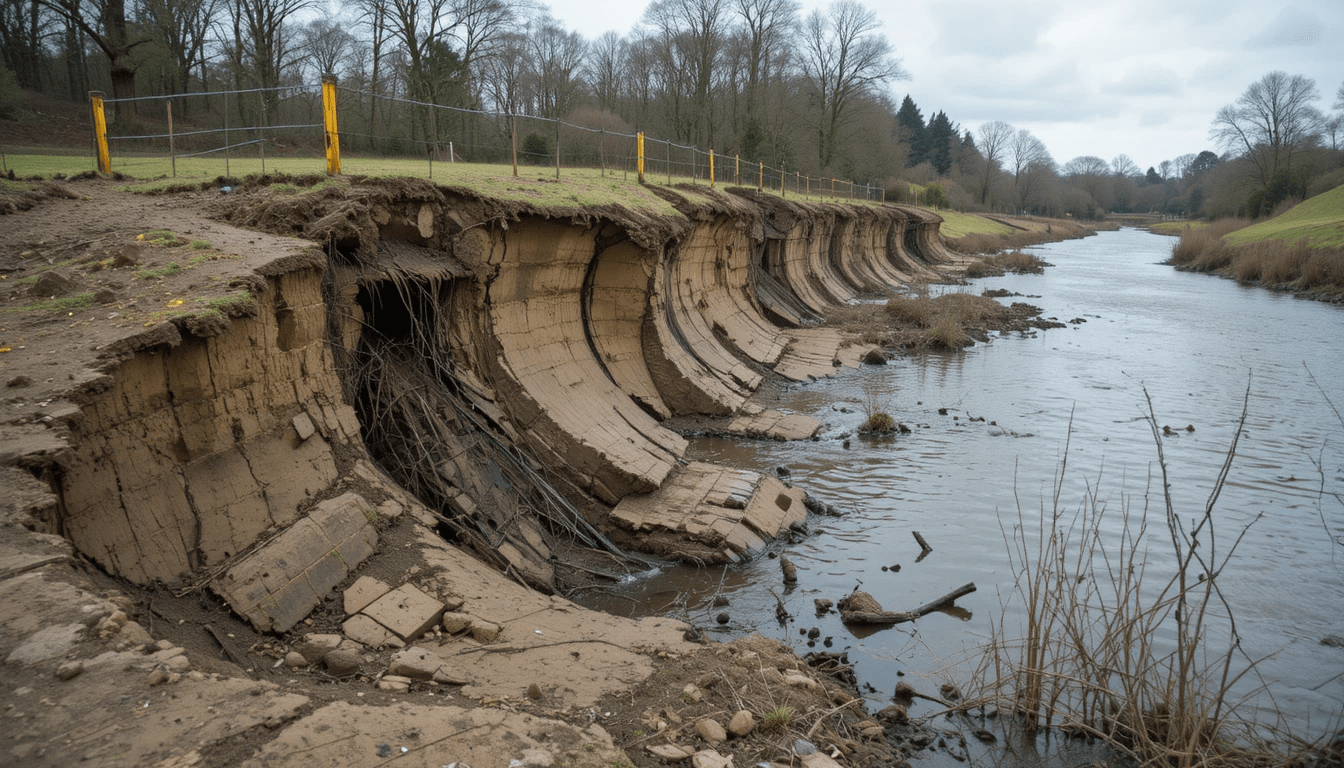
And then one night the whole section of bank simply gave way.
No fireworks. No dramatic roar. Just a quiet surrender.
People woke up to find giant chunks of land missing, trees leaning at strange angles, and fencing going up almost immediately to stop anyone wandering too close. That’s what really made the whole situation sink in—normal everyday space suddenly looked fragile.
The news started spreading fast. Everyone began asking what caused the riverbank collapse Iford Playing Fields, and honestly, the story wasn’t as simple as one big event.
A River That Keeps Changing Its Mind
Rivers don’t stay politely inside painted lines. They shift, they carve, they drag soil away grain by grain. Standing by the bank now, you can actually see how the flow hits one side harder than the other. Over time that pressure builds up, especially in soft soil like the kind sitting under Iford Playing Fields.
Add in several weeks of relentless rain, the type that doesn’t feel dramatic but slowly soaks every layer of earth, and the problem becomes obvious.
Waterlogged ground loses its grip. It stops holding onto itself.
And honestly, if you’ve walked there after a storm, you’ve probably felt it—the squelching, the softness, the way your foot sinks just that half inch deeper than usual. Multiply that by thousands of litres of water and a fast-moving river, and suddenly the “unexpected” collapse doesn’t feel so unexpected anymore.
Some blamed tree loss, others pointed to growing foot traffic near the fragile edges. Both probably played a part. Real life rarely has one neat villain.
The Real Impact on the Community
What surprised me most wasn’t the physical damage. It was the emotional punch.
This place isn’t just a green patch on a map. It’s where parents teach their kids to ride bikes, where local teams practice, where people sit by the river to clear their heads for a while. Losing even a small piece of that feels strangely personal.
After the riverbank collapse Iford Playing Fields, regular walkers had to reroute, families avoided the taped-off areas, and the whole field suddenly felt… smaller. Not ruined, but changed.
There’s something quietly sad about seeing nature reclaim the space you always assumed was safe.
Why This Collapse Matters More Than It Seems
It’s tempting to shrug and say, “Well, riverbanks erode.” But what happened here is a reminder of how climate patterns and human habits intersect.
Heavier rain isn’t rare anymore. Winters feel wetter. Rivers swell faster. And outdoor spaces we take for granted are starting to feel the pressure.
The riverbank collapse Iford Playing Fields is basically a warning without the alarm bells. It’s the kind of event that says, “Hey, maybe we need to rethink how we use fragile river areas.”
Not in a doom-and-gloom way, but in a realistic one.
Can It Be Fixed? Probably. But Properly.
Everywhere you look now, there are discussions about stabilisation — fancy word, simple idea. The aim is to help the bank hold itself together again.
Some of the ideas being floated around sound promising:
Reinforcing the bank with natural materials
Things like willow stakes, biodegradable rolls, and deep-rooted vegetation can help the soil lock together again without ruining the landscape.
Giving the river a bit more breathing room
Shifting footpaths slightly inland could reduce pressure on the weakest sections.
Long-term monitoring
Not just fixing the damage once, but keeping an eye on water levels, soil movement, and early warning signs.
Honestly, the right mix of engineering and nature-based solutions could make the area stronger than it was before.
But the important part is caring enough to do it right.
Why People Are Still Talking About It
The riverbank collapse Iford Playing Fields became such a talking point because it taps into something bigger. We’re all starting to see how fragile our favourite places are becoming. Flood events, erosion, weird weather—they’re showing up more often than they used to.
And Iford Playing Fields just happened to be the place where those changes became impossible to ignore.
It’s a reminder that nature is always negotiating with us, even when we’re not paying attention.
A Personal Hope for the Fields
Every time I walk past the fenced area now, I catch myself imagining what it’ll look like in a year or two. I really hope the space gets the attention it deserves—not just for safety, but because places like this matter.
When the land gave way, it shook more than soil. It shook the idea that our local green spaces are unshakeable. But maybe this will be the moment that pushes the community and planners to give the area a stronger future.
I’d love to see that.
The riverbank collapse Iford Playing Fields was a setback, sure. But it doesn’t have to be the end of the story.
FAQs
Why did the riverbank collapse at Iford Playing Fields?
Rain-soaked soil, constant river erosion, and general land weakening created the perfect conditions for a sudden slip.
Is the area still safe to visit?
Yes, as long as you respect the fenced-off zones and warning signs. The unstable sections are clearly marked.
Can something like this happen again?
If nothing changes, yes. Without proper reinforcement and monitoring, erosion tends to return.
Who’s responsible for fixing it?
Usually, it’s a mix of local councils, environmental teams, and land management authorities working together.
Will the fields ever look the same again?
Probably not exactly the same — but that doesn’t mean they can’t be restored or even improved with the right approach.
